Every essential oil monograph on this site eventually says the same thing: dilute before you apply it to skin. This is the page that explains what that actually means in drops and millilitres, which carrier oil to reach for, and the handful of safety rules - patch testing, sun exposure, storage - that matter more than people think.
None of Zea's essential oils are listed medicines. They are cosmetic and aromatherapy products, used for fragrance and topical comfort, and nothing here should be read as medical advice or as a claim that any oil treats or cures a condition. If you are pregnant, breastfeeding, treating a young child, managing a chronic health condition, or caring for a pet, talk to a doctor, pharmacist or veterinarian before using essential oils on or around them.
What is a carrier oil, and why does dilution matter?
A carrier oil is a plant-derived fatty oil - almond, jojoba, coconut, olive - used to "carry" a concentrated essential oil onto the skin at a workable strength. Essential oils are not oils in the culinary sense. They are volatile, highly concentrated plant extracts: a single 15 mL bottle of lavender oil can represent several kilograms of raw plant material. Applied undiluted ("neat"), that concentration is far more likely to irritate or sensitise skin than to do anything useful.
Robert Tisserand, co-author of the widely cited reference text Essential Oil Safety, frames dilution as solving two separate problems: local skin reactions (irritation, sensitisation, phototoxicity) and, at higher exposure, systemic effects.1 A carrier oil doesn't just make an essential oil go further - it is the buffer that keeps concentration inside a range skin can tolerate, while still letting you use enough of the essential oil to notice a scent or a sensory effect.
As a general rule, treat "diluted" as the default and "neat" as something you don't do outside of a very small number of oils and a trained aromatherapist's guidance. This article, and every single-oil guide on the Zea Health Library, works from that assumption.
The essential oil dilution ratio chart
Dilution is expressed as a percentage - the proportion of essential oil in the finished blend. The table below converts the ranges commonly cited in aromatherapy safety literature1,2 into drops, using the industry-standard measuring convention that 1 mL contains approximately 20 drops from a standard dropper insert.3 This is a widely used approximation, not a precise scientific unit - drop size varies with the oil's viscosity and the dropper fitted, so treat the drop counts below as a practical guide, and use a millilitre measure or a set of kitchen scales for anything you need to get genuinely precise about.
| Dilution | Drops per 10 mL carrier | Drops per 30 mL carrier | Typically suits |
|---|---|---|---|
| 0.5% | 1 drop | 3 drops | Sensitive or compromised skin, very young children, facial use on reactive skin1 |
| 1% | 2 drops | 6 drops | Facial oils and serums; general guidance for children, older adults and anyone pregnant1,2 |
| 2% | 4 drops | 12 drops | Everyday body oils, lotions and massage blends for healthy adults1,2 |
| 3% | 6 drops | 18 drops | Short-term, targeted body-oil use (a specific muscle or joint area) rather than daily whole-body application1 |
| 5% | 10 drops | 30 drops | Short-term spot use only (a small area, for a limited number of days) - not for daily or whole-body use1 |
| 10% | 20 drops | 60 drops | The upper end cited for small, localised, short-term use (for example a rollerball on a single spot) - not a general-purpose strength1 |
A few things worth being explicit about, because most dilution charts online skip them:
- These are ranges from aromatherapy safety literature, not a single universal law. Tisserand Institute publishes ranges rather than fixed numbers - 0.2 to 1% for sensitive or compromised skin, 0.5 to 1.2% for facial cosmetics, 1 to 3% for body oils, and up to 10% for specific short-term uses like acne spot treatment or a pain rollerball.1 We've picked representative percentages inside those ranges to build a usable chart, and rounded the resulting drop counts to whole numbers.
- Pregnancy and children need a professional, not a chart. The general guidance in aromatherapy references is to stay at the lower end of the range (0.5 to 1%) and avoid several specific oils entirely, but individual circumstances vary too much for a blog post to substitute for advice from your doctor, midwife or a qualified aromatherapist.1,2
- Never use essential oils on or around cats. Cats metabolise many essential oil constituents differently from people and dogs, and veterinary guidance treats them as a distinct, higher-risk case rather than "just a smaller dose." Ask a veterinarian before using any essential oil, diffuser or diluted blend in a household with cats, and be cautious with dogs and other pets too.
- Never take essential oils internally. Nothing in this article, or anywhere on the Zea Health Library, is instruction for ingestion. NAHA's position is that internal use should only happen under the guidance of a qualified health professional using a product specifically labelled for that purpose - not a home dilution.2
Choosing a carrier oil
The carrier oil you choose changes how a blend feels, how long it lasts on the shelf, and how likely it is to sit on top of the skin versus soak in. There's no single "best" carrier - it depends on skin type, the area you're applying to, and how quickly you want the oil absorbed.
| Carrier oil | Feel / absorption | Typical shelf life | Comedogenicity |
|---|---|---|---|
| Fractionated coconut oil | Very light, fast-absorbing, odourless, stays liquid at room temperature | Long (fractionation removes the components most prone to oxidising) | Low5 |
| Sweet almond oil | Medium weight, smooth glide, moderate absorption | 6-12 months once opened | Low to moderate5 |
| Jojoba oil | Light, closely resembles skin's own sebum, good for facial use | Long - naturally resistant to oxidation | Low5 |
| Grapeseed oil | Very light, slightly astringent, absorbs quickly | 3-6 months once opened | Low to moderate5 |
| Extra virgin olive oil | Heavier, slower to absorb, distinct scent | Several months to a year | Moderate5 |
| Rosehip seed oil | Light, fast-absorbing, often used on the face and for scarring | Short - 3-6 months, prone to oxidation, best refrigerated once opened | Low to moderate5 |
A general pattern in that table: the lighter and faster-absorbing an oil is, the shorter its shelf life tends to be, because the same fatty acid structure that makes an oil feel light on skin also tends to oxidise faster once it's exposed to air and light.6 Comedogenicity ratings (how likely an oil is to clog pores) come from cosmetic-chemistry testing on a 0-5 scale and vary between sources and skin types, so treat them as a general guide rather than a guarantee - patch testing on your own skin still matters more than any published rating.
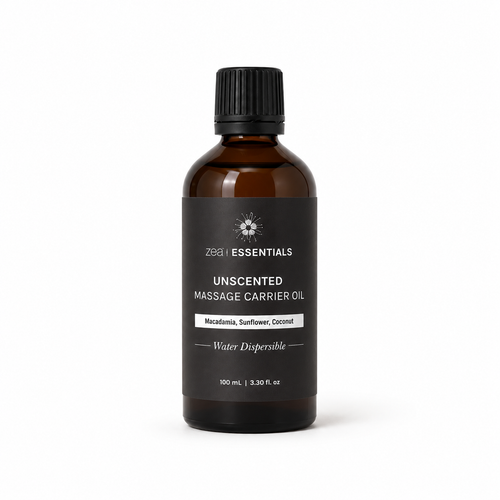
Zea's Unscented Massage Carrier Oil is a fractionated coconut oil base for exactly this purpose - it's odourless so it doesn't compete with whatever essential oil you're blending, and its long shelf life means it won't turn before you've used it up.

How to patch test before you use a new blend
Patch testing is the single most useful five-minute habit in this whole article, and it's the step people skip. The method used in dermatology and reflected in general aromatherapy guidance is straightforward:
- Mix your diluted blend at the strength you actually plan to use (don't test at a weaker strength than you intend to apply).
- Apply a small amount to an unobtrusive patch of skin - the inner forearm is the standard choice - and leave it uncovered or lightly covered.
- Keep the area dry and avoid washing it for the test period.
- Wait 24 to 48 hours. Some allergic contact reactions take this long to appear, which is why a five-minute wrist sniff test doesn't tell you much about a skin reaction.7
- Check for redness, itching, swelling or blistering. Any of these means don't use that blend on your skin - not just at that strength, but reconsider the oil itself.
If you have a history of skin allergies, eczema, or reactions to fragranced products, patch test every new blend, not just new oils - the carrier oil and the combination of oils in a blend can both be the trigger, not only the "active" ingredient you're focused on.

Phototoxicity: why some oils and sun exposure don't mix
A handful of essential oils make skin more reactive to UV light for a period after application - a reaction called phototoxicity, distinct from a normal sunburn. The oils responsible are almost always cold-pressed citrus peel oils - think bergamot, lemon, lime and grapefruit extracted by cold expression rather than steam distillation.
The mechanism is well documented: cold-pressed citrus peel oils contain furanocoumarin compounds (bergapten and related molecules) that absorb UV energy and can trigger an exaggerated skin reaction - redness, dark patches or blistering - on sun-exposed areas after sun exposure, and the cited precaution is to keep treated skin out of direct sun for at least 12 hours.8 Steam-distilled citrus oils, and "FCF" (furanocoumarin-free) bergamot variants produced by removing those compounds, don't carry the same risk, because the molecule responsible is too large to pass through steam distillation.8
The practical rule: if a blend contains a cold-pressed citrus peel oil, keep the treated skin out of direct sun and tanning beds for at least 12 hours, longer for higher concentrations. This matters for a rollerball or body oil you might apply before heading outdoors - check the extraction method on the label, and when in doubt, treat any citrus peel oil as photosensitising.
Oxidation and storage: why an old bottle is a different product
Essential oils change chemically as they age, particularly once a bottle has been opened and exposed to air, light and heat. Oxidation converts some of the original aromatic compounds into new ones - including peroxides and other reactive byproducts - and research on tea tree oil specifically found that oxidised oil is a substantially stronger skin sensitiser than fresh oil, with several of the oxidation byproducts identified as the main allergens responsible in patch-test-confirmed reaction cases.9
What this means in practice:
- Store oils in dark glass, in a cool spot, away from direct light. UV exposure accelerates oxidation independently of ordinary air contact.
- Keep lids tightly closed and minimise how long a bottle sits open.
- Citrus and other light, high-monoterpene oils oxidise fastest - use these within a year or so of opening. Heavier, resinous oils (think Kunzea, patchouli, sandalwood) tend to hold up for longer.
- An oil that smells noticeably different, sharper or more "off" than when you bought it has changed chemically, and that change is exactly the kind that raises sensitisation risk. If in doubt, don't use it on skin.
What "100% pure" actually means (and doesn't)
"100% pure essential oil" is a common label claim, and it's a reasonable shorthand for "not diluted with a carrier and not synthetically extended" - but there is no government body that regulates or verifies the term itself before a bottle reaches a shelf. A brand can print "100% pure" on a bottle regardless of whether it has been independently tested.
The gold-standard verification method used across the industry is gas chromatography-mass spectrometry (GC/MS) testing, which separates and identifies the individual chemical constituents in a batch of oil and can flag synthetic additives, adulteration with a cheaper oil, or a constituent profile that doesn't match the plant it's supposed to come from. GC/MS is a genuine analytical tool, not a marketing term - but a brand still has to choose to test every batch and be willing to publish or share the results, since nothing compels it to. That's the real question worth asking a supplier: not "is it 100% pure," but "can I see the batch-specific GC/MS report."
For a deeper look at how purity testing actually works and what a certificate of analysis should show, see our companion article on how essential oil purity is verified.
Putting it together: a simple worked example
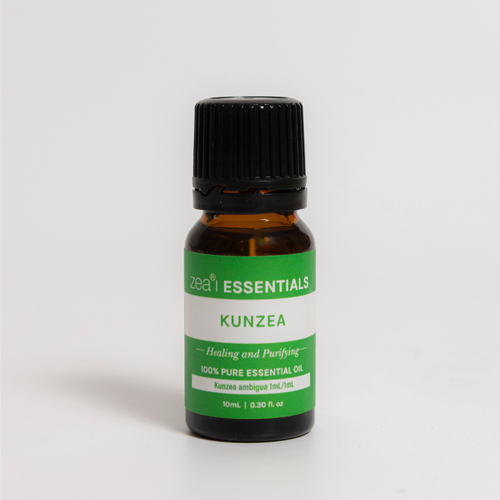
Say you want a 2% body oil blend in a 30 mL bottle of Unscented Massage Carrier Oil. From the chart above, that's 12 drops of essential oil topped up with carrier oil to the 30 mL mark. If you're blending Kunzea Tasmania Essential Oil with something else, split those 12 drops between the oils in whatever ratio suits the blend you're after - the 2% ceiling applies to the total essential oil content, not to each oil individually.
Shake well before each use (essential oils and carrier oils will separate slightly over time), store away from light, and patch test before applying it more broadly. If you'd rather skip the measuring altogether, a pre-diluted, ready-to-use product - like Zea's Multipurpose Rescue Balm or the Therapeutic Roll-Ons Trio - is formulated at a tested, consistent dilution so there's no maths involved.
Frequently asked questions
Can I ever apply essential oil undiluted ("neat")?
As a general practice, no. A very small number of oils are sometimes used neat by trained aromatherapists in specific circumstances, but that's a professional judgement call, not a home default. Dilute first.
How much essential oil is in a "few drops" in a diffuser?
This article covers topical dilution specifically. Diffuser use isn't a skin-contact dilution question in the same way, but the same principle applies: less is generally better, and manufacturer guidance for your specific diffuser model is the best source for drop counts.
Is a higher dilution percentage always "stronger" in effect?
Not necessarily in a linear way, but a higher percentage does mean more essential oil constituents in contact with skin, which is the variable that drives both any topical effect and any risk of irritation or sensitisation. More concentrated isn't automatically better.
Do children need a completely different chart?
Children need lower concentrations and, for some oils, avoidance altogether - this is a case where general guidance genuinely isn't a substitute for advice from a paediatrician, GP or qualified aromatherapist who knows the child's age and health history.
Which Zea essential oils are cold-pressed citrus and need the sun caution?
Check the extraction method listed on each product page in our essential oils collection and our Australian native essential oils collection - if a citrus oil is cold-pressed rather than steam-distilled, treat it as photosensitising and avoid direct sun on treated skin for at least 12 hours.
References
- Tisserand Institute, "Dilution for essential oils" - dilution percentage ranges by use case and safety framing.
- National Association for Holistic Aromatherapy (NAHA), "Exploring Aromatherapy: Safety" - general dermal and internal-use safety guidance.
- "Drop (unit)" - background on the long-standing pharmacy convention that treats a drop as approximately 1/20 mL, which is the basis of the 20-drops-per-mL figure used throughout this article. Treated here as an approximate working convention, not a precise standard.
- "Biological Activities and Safety of Citrus spp. Essential Oils," PMC (National Institutes of Health) - background on citrus essential oil constituents and safety profile referenced for general essential oil metabolism and species-specific sensitivity context.
- Comedogenicity ratings are drawn from standard cosmetic-chemistry rating scales widely used in dermatological and cosmetic formulation literature; ratings can vary by source and individual skin type.
- "Biological Activities and Safety of Citrus spp. Essential Oils," PMC (National Institutes of Health) - discussion of oxidative degradation of unsaturated fatty acid and terpene-rich oils.
- DermNet NZ, "Allergic contact dermatitis to essential oils" - patch testing methodology and timing for allergic contact reactions.
- "Biological Activities and Safety of Citrus spp. Essential Oils," PMC (National Institutes of Health) - furanocoumarin content of cold-pressed versus steam-distilled citrus oils and phototoxic mechanism.
- de Groot & Schmidt, "Tea tree oil: contact allergy and chemical composition," Contact Dermatitis (2016) - oxidation of tea tree oil constituents and increased sensitisation potency of oxidised oil.